While the history of formal deaf art is relatively short (spanning approximately fifty years), it has been dominated by white deaf artists. Art made by deaf people has existed for hundreds of years, but it was not until the 1970s that deaf artists intentionally created art to portray the self, specifically focusing on the deaf experience. This led to the establishment of Deaf View Image Art (De’VIA) movement in 1989. Since then, deaf, white, mostly straight (several of the founders of De’VIA are openly gay or lesbian), cis-gender, and able-bodied artists’ works have been showcased in public spaces or taught in educational settings. This focus has meant that many of the layered complexities that comprise the deaf community are left out of the popular conception of deaf art.
It was not until the rise of social media that BIPOC, LGBTQ, DeafBlind, and/or DeafDisabled artists came into general consciousness. They had been around and had been creating works reflecting their experiences prior to social media, but the works were not seen by others. These artists are now much more recognized and revered within the deaf community, but not as much outside that sphere.
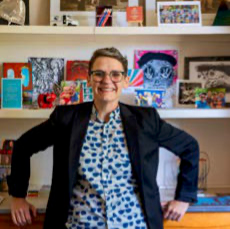
The goal of this gallery is to give the audience broader access to the rich and multi-dimensional world that makes the deaf community. This gallery explores the other identities that deaf people have in addition to—or completely independent of—their deafness. The artists represented have multiple identities and some or all of those identities are portrayed in their works: a transgender artist with multiple disabilities and chronic illness; a transgender artist with Treachers Collins, a DeafBlind poet, a linguistically-deprived Black artist, a Latine poly queer fat artist, and a Latinx DeafBlind poet and artist.
In the deaf community, De’VIA has long been considered a movement that privileges deaf, white, straight, cisgendered, and able-bodied artists and their stories. De’VIA artwork typically includes motifs of hands, eyes, ears, and mouth, among others. The face, eyes and the hands are usually magnified, emphasizing the importance of those body parts for communicating in a two-dimensional way. However, when reviewing this gallery of non-De’VIA works, you will see that the figure of the body often takes precedence over the face, which is likely to be represented in abstract figures or not included at all, as seen in the works of Sean-Michael Gettys, Jaimeson Pleasants, and Selena Alvarez.
Hands are used for the purpose ofa tactile experience of understanding and communicating with the world, such as in the case of DeafBlind poets John Lee Clark and Rossana Reis. De’VIA works also typically include representations of Deaf history through a white person’s lens. Takiyah Harris is the first Black Deaf artist to create works that tell Black Deaf stories left out of the canon of Deaf history.
Through this gallery, I invite you to consider the complexity and the depth of the deaf community. In addition to the deaf community’s many preferences in language modality and hearing identities, there are also gender, cultural, sexual, racial identities and disabilities that shape a deaf person’s experience in the world. While all of these artists are deaf, not all of them consider their deafness as what completely defines them.