May We Unravel
clefting as access practice as risk
rachel west
Court Kessler
untitled
Photography
Image Description
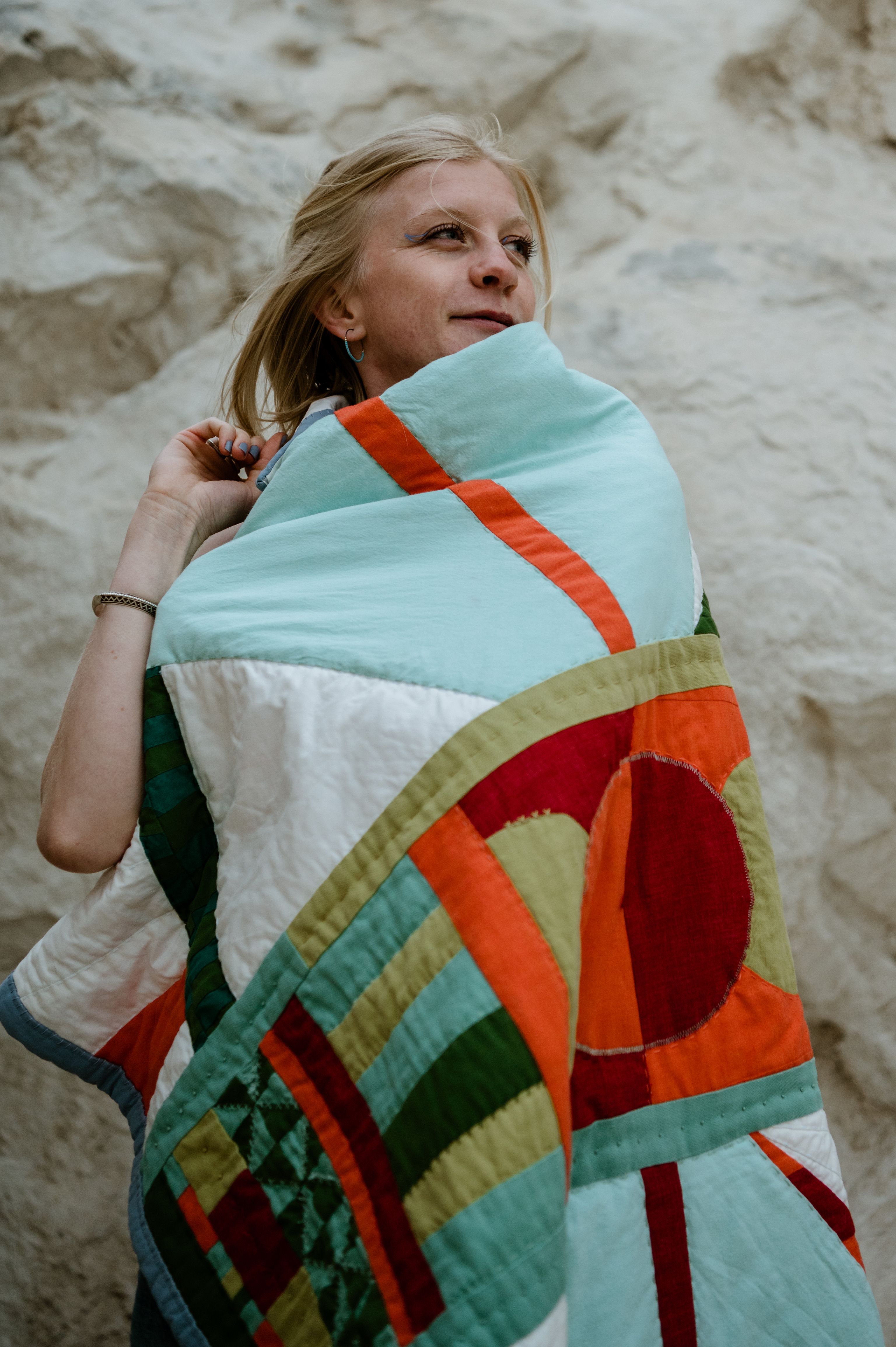
My quilt wraps around me, cocooning me as I (rachel) stand in front of a craggy white rock face. Only my left arm peaks out, bent up towards my shoulder. Wind teases my blonde hair as I smile softly, looking off towards a faraway horizon. The quilt has an energy all its own, arcing and jagging in hues of orange, reds, and greens. Photo by Court Kessler. Ojito Wilderness, Pueblo land. (rachel west)
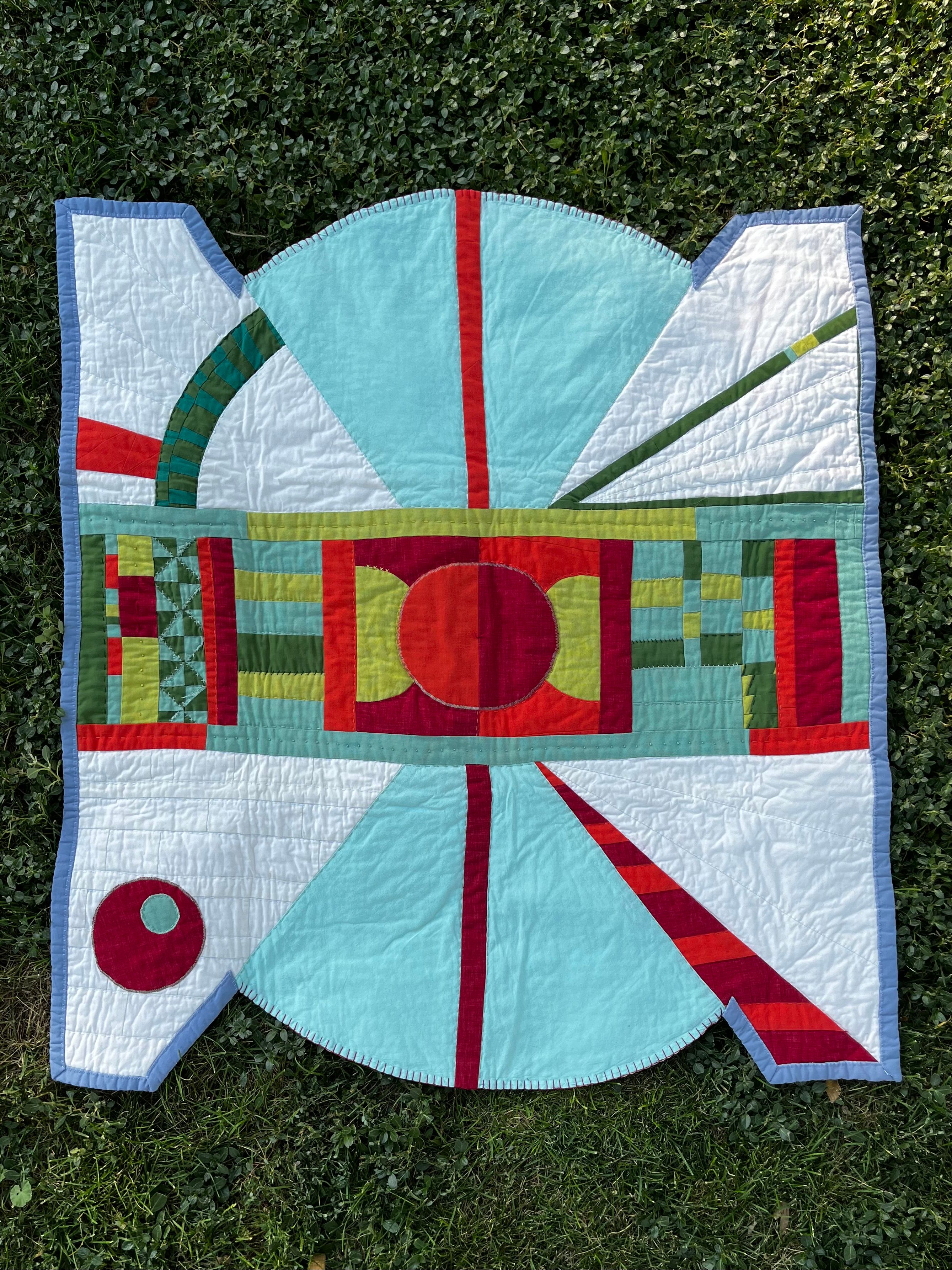
I come to artistic practice by way of quilters, ceramicists, writers, dancers, and my own younger self who ask me, indirectly or directly, to be open to and tend to the way things fall apart. This manifests through tapestry-making of all kinds: patchwork, collages, writing, dreaming. I delight in piecing things together while allowing the work to take on its own form, embracing inherent unruliness.1 The quilt I crafted in conversation with my mother’s dissertation2 unraveled partially in its first wash; a creative choice and collaboration I chose to honor instead of disappear. Holey—holy—textiles abound. This turn to creative dissolution is a material metaphor for access practice, but it is also a provocation for being in this world. A textile prayer that embodies part of my commitment to (re)claim an innate, clefted aesthetic; this unraveling is clefting in action.
Both quilted and quilter, I belong to a lineage of wide open ones.3 My mother and I came into this world with cleft lips and palates, forty-one years apart. Clefted folks are born—and live—in the space between: edgewalkers.4 The success of our ‘care’ within contemporary culture hinges on our very disappearance. Beautifully, my mother’s and my presence tugs at this outcome. Such a complex inheritance, embedded in the austere oil-rich lands of my west Texas birthplace, taught me how to make home within a test site. Amidst a culture committed to extraction and beautified façades at all cost, my innate openness stirs unease in many. Like my mom, I spent my childhood being woven and sutured into others’ vision of my embodiment, each fiber of my visage arranged into one fabricated whole. My whiteness was celebrated when my queer, femme, disabled selves behaved. Read: when my mouth was shut. My lineage of care encompasses those who understand my clefts as problematic chasms to close, of which erasure was the only option, and those who encourage me to pull at the threads and bare (sic) witness to the openness therein. Reveling in the abyss is my birthright.
It is not as simple as asking, as many do, would I have preferred not to have been sutured? The question now, from my patchwork body, can only be: what do I know because I have been sewn whole and yet still yearn to live and learn in the spaces beneath this façade? Clefting is a reverent, mischievous longing to embrace the places that have been deemed too risky, problematic, or grotesque to embody. With such sweet sadness, I still find it difficult to share in this pursuit with other clefties. Our disappearance has been made so thorough as to often revoke access to our own culturally disabled experience. This is the slipperiness of care.5 I long for the day when we can face each other on our own terms, grounded in our own exquisiteness. To do so, we must unravel what has been cured. A clefting practice not only honors inherent gaps, but also embraces our fissures by pulling apart a falsely narrated, culturally accepted whole. Clefting invites us to unravel a normalized façade so that we may land in an openness that beckons more multifaceted realities.
I trust that clefting—unraveling—is central to my role as an access and culture worker in the arts. Like my quilt, clefting becomes a conduit by which we can explore and deepen in cross-disability practice. Access is not a bridge, nor a suture6, nor a stopgap. At its ever-evolving best, I believe access continuously reveals all of the ways in which you and I are different. Rather than creating an impossibly unanimous experience, equitable access dares us to revel in the gaps between you and I. It asks and offers us ways to witness each other and ourselves as we are within a larger tapestry. Access becomes a clefting practice that uproots and unravels the status quo, should we accept the invitations.
Access is not a bridge, nor suture, nor stopgap
at its ever-evolving best, access reveals all of the ways in which you and I are different
Unraveling cannot happen in isolation. I am forever changed by the disability arts ensemble Kinetic Light. Their 2017 residency at MANCC7 tugged at my own threads of queerness and racialized disability; threads that I could sense but not yet retrace. I was formally woven into Kinetic Light’s fabric in 2019. My work evolved as the organization grew, ultimately crafting the inaugural role of Access Manager + Cultural Steward which centers accessible experience within and beyond Kinetic Light. To work with Alice Sheppard (KL founder, Artistic Director) and Laurel Lawson (KL Access + Tech Lead) is to be in relationship with inexhaustible exploration and inquiry. Both of them beckoned fissures into my foundations of disability, equity, and artistic practice in the most capacious ways.
I interface frequently with staff at arts organizations who are keen to bring more accessible practices into their environment, or so they say. The underlying, albeit ‘good intentioned,’ desire in many of these initial conversations lies in the (typically nondisabled) assumption that access exists to bridge a gap: between disabled and nondisabled experience; ‘normal’ and ‘abnormal;’ culturally acceptable and othered. Though seemingly benign and even lauded, the sneaky, slippery assertion in this approach is that access serves to erase difference. Successful access happens here when the nondisabled ‘public’ is unaffected and largely unaware that we are sharing space. And when the success of our own cure demands that we—disabled artists, access workers, and audiences—also buy into the fallacy of masked nondifference, we may become entangled and complicit in this cultural precedent, too. This approach to accessibility not only lacks luster, but entirely revokes disability-centered agency, creativity, and choice. When access serves to disappear a multifaceted disabled experience, we wholly miss a much more spacious potential. It seals all of us off from the possibility that we could coexist amidst our innate openness; it disappears that generative gap.
Sophie Strand, author and self-proclaimed compost heap, writes that in order to survive we must risk new shapes by celebrating the breach.8 It is a risky endeavor, clefting. Rather than bridging a gap, new shapes emerge when we become open to unraveling a false (w)hole. The process is not void of friction, discomfort, or unsteadiness.9 It is a process informed by disabled experience, after all. The invitations that pull us in are crucial: Where do things unravel? How can we unravel? How can we prepare for and honor this glorious unraveling, together?
Court Kessler
untitled
Photography
Image Description
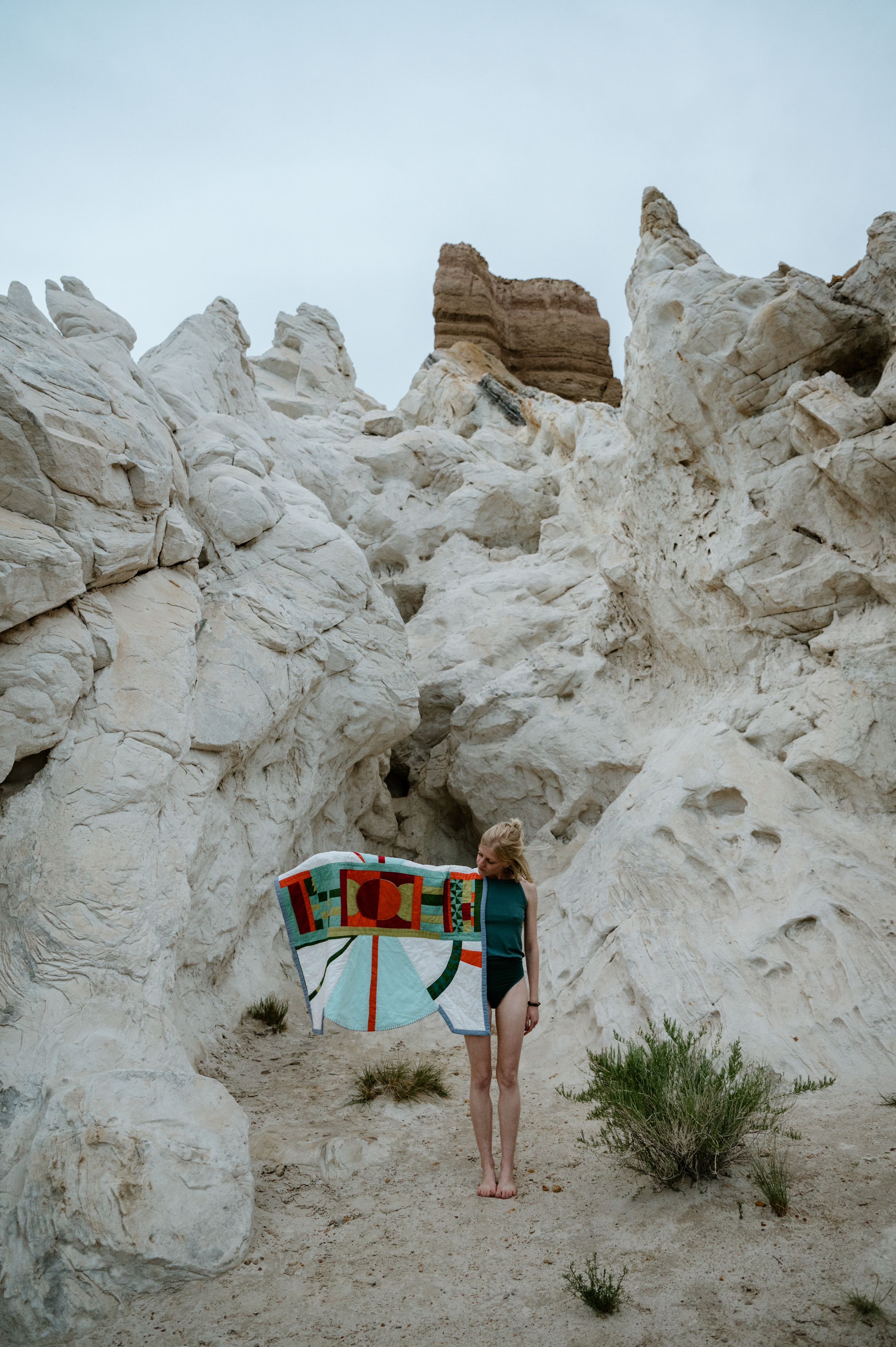
Standing barefoot at the mouth of white and rocky chasm, I (rachel) look down across my quilt which is draped over my outstretched arm. Swaying in a little breeze, the quilt becomes a long, flat extension of my body. Oranges, blues, greens. I’m small against the huge rock that rolls up into the pale blue sky behind me. My white skin and blonde hair mirror the hues in the rock’s shadows; my teal top and green underwear reflect pieces of the quilt. Photo by Court Kessler. Ojito Wilderness, Pueblo land. (rachel west)
Court Kessler
untitled
Photography
Image Description
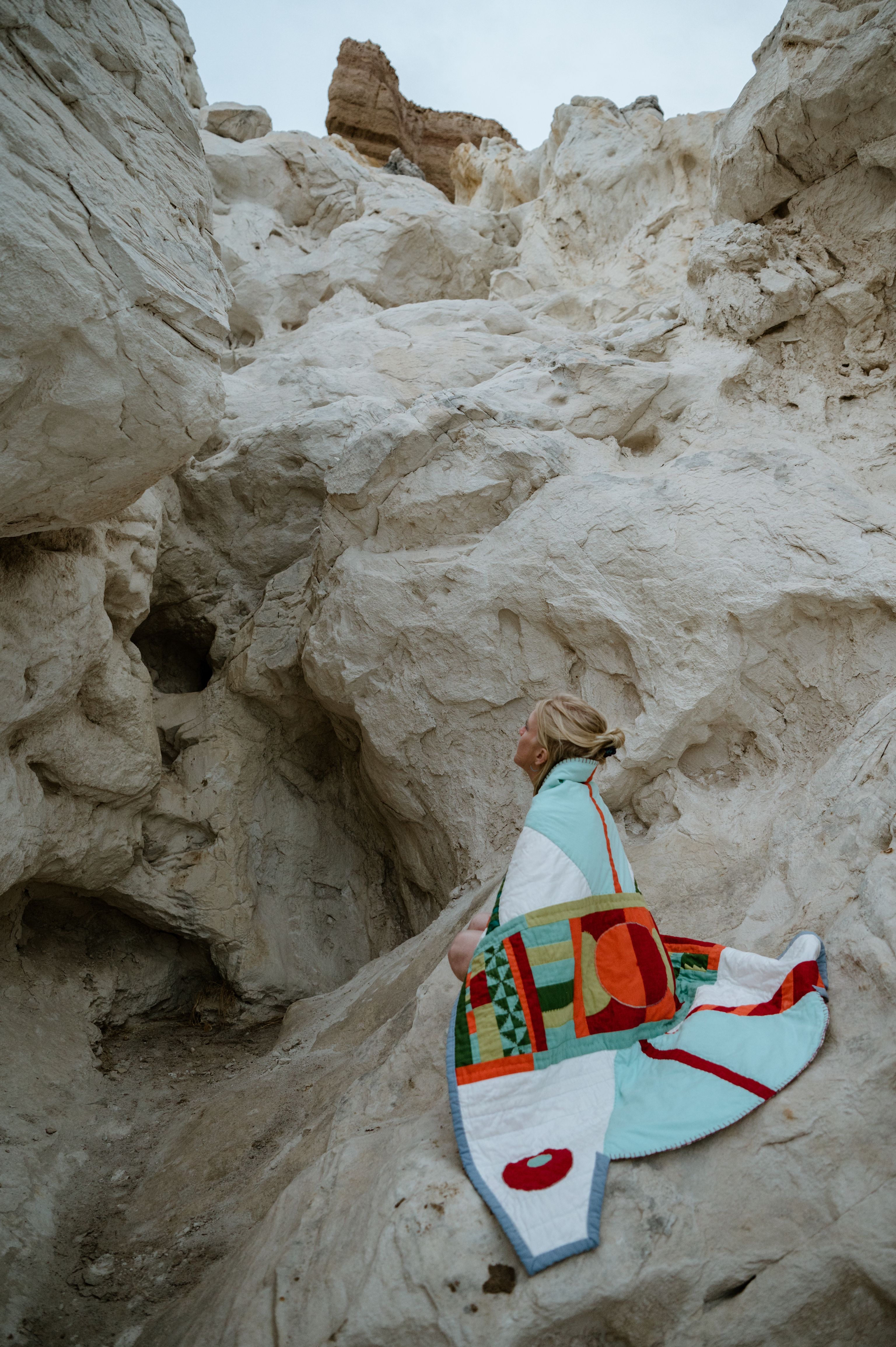
Gazing into the divine divide: I (rachel) crouch at the base of a steep, rocky escarpment, peering up into the craggy chasm before me. My quilt wraps around me, curved and jagged edges rippling from my body to the rock’s surface behind me. My skin is pinkinsh white and my blonde hair is bundled up halfway; the quilt hums in vibrant hues of green, orange, red, and stark white. Photo by Court Kessler. Ojito Wilderness, Pueblo land. (rachel west)
Where do things unravel? In order to unravel, we must first start with something tangible. Teasing the edges and pulling at threads requires something to already exist that we can tug. Access, as invoked by ADA compliance, generally encompasses that which is minimally needed: ramps, elevators, accessible bathrooms. Yet as I write for disability community, we know that this foundation appears deceptively and unrealistically solid. Compliant access does not create equity, nor does it tend to invite wonder or make space for curiosity. Compliant access is exceedingly good at maintaining an ‘equitable’ façade without risking any fissure in an institution’s established culture.
It is one thing to be able to sit in a theater, and it is quite another thing to be able to experience the work in that theater through a multiplicity of senses and skills. With sole focus on compliant best practice, artistic intent gets tangled beneath rote, politically correct or nondescript audio description.10 Audiences in wheelchairs are still relegated to sparse sections of the house, and only at ‘kids’ matinees can we respond wholeheartedly to the work in real time. What an immense impact it makes to enter a space, experience art, and feel that all of it was crafted to better honor your exquisite, disabled bodymind. Generations of elders devoted themselves to fighting for the tangible, physical access that has become part of the fabric of my generation’s life. In gratitude for this lineage of ongoing advocacy, we can and should unfurl beyond it.
How can we unravel? It bears repeating that unraveling rarely happens on its own. If you knit, you know that the willingness to unwind (or as I call it, ‘tink:’ knit backwards) is crucial to the process. Each unraveling tells a story of interconnection, sustainability, and care (or lack thereof). When access is an afterthought or mere commodity, the entire experience dissolves and dampens. And even the most accessible, equitable practices become tired when they are unable to evolve alongside the art itself. To sustain such creative risk, unraveling must be intentional and integral to our practice. This is an act of devotion: the sheer desire to unwind, repurpose, and alchemize one thing into something new implies a reverence for what came before. While we know the ADA is not enough, we are not casting it off entirely. We are tending and tugging at its threads, pulling them into new ways of being.
Sometimes this happens magnificently, and often the grand experimentation of it all creates friction and conflict. This is not a sign of access gone awry. These forces celebrate our coexistence. They are indicators of the intrinsic rub of culture change. We honor this coexistence not by disappearing each other or our needs, but by embracing the inherent space between us. As we unravel, we must find ways to care for the realities of tense, sometimes surprising, creatively abundant chasms. And out of this paradoxical tension, we create anew.
Court Kessler
untitled
Photography
How can we prepare for this unraveling? When I speak to presenters, much of my initial work is to sort out the tangible details of physical access. How many ASL interpreters can be available in the lobby? Where are accessible exits? How many accessible bathrooms exist and how does this impact house open and intermission? Can we pull out rows of seating to create a more versatile space? Questions like these are necessary. They get us in the room together and begin to pull at the edges of our personal and institutional assumptions about how access exists. Yet this kind of access is just a piece of the whole.
Unraveling can be a jarring experience. Committing to the fray tugs at an institution’s impulse to keep things neat and compartmentalized. It tugs at our own masks, as well. No pre-existing pattern exists for what we will co-create once these threads are laid bare; we learn by curious tugging and weaving, together. In order to cultivate more spacious potential, we need to interrogate what we fundamentally value in artistic and personal practice. How are the ways we approach access and disability indicative of our beliefs about who should be centered in creative experience? How are we building capacity to live in the fray, without rushing to create a new façade out of fear and uncertainty? In my practice, I do not equate access with accommodation. Accommodations are temporary homes, convenient reconciliations by definition. Very little about equitable artistic access is convenient, nor should it be if we also believe that art is more than a complacent commodity. Once we begin to tease the edges of a cultural fabric, it is futile to try and piece it together in the same way. The fabric must change; may unraveling be a cherished impetus.
May our unraveling be constant and interwoven
How can we honor this unraveling, together? When we allow ourselves to be undone by the access we create together, we fissure false foundations. We unravel assumptions about where disability exists; of a white, physically disabled monolith; of a central, nondisabled reference point. We cleft façades of care that close us off from more genuine connection. Access, at its most splendiferous11, has the capacity to allow us to be (more) fully witnessed in community. Equitable access tugs and pulls, beckoning us beyond compliancy and complacency. Art is a means of expressing and generating ineffable feeling. It is a means of articulating a gap. The gap itself is generative. We exist at our fullest if, and assuredly when, we can revel luxuriously and (mostly) without fear in the spacious chasms between and within each other. That will be a sign of access well lived.
A parting thread and an ongoing prayer
As quilt(ed) became quilter, I stitched you together piece by piece. All the while, you affirming my unending desire to unravel. How effortlessly you bare your threads! And how lovingly I witnessed you (un)snarl. Not a problem to be fixed, but a chasm to celebrate. A defiant, effortless breach into another realm.
What an incredible relief: we, sown not sewn.
This quilt is for us, split open and clefted as we are. May it beckon us to each other, mouthing and claiming our wild lineage. Face to face, I see you. In me.
May our unraveling be constant and interwoven.
12Notes
- Priya Srinivasan’s essay, “A ‘Material’-ist Reading of the Bharata Nayyam Dancing Body: The Possibility of the ‘Unruly Spectator’” from Worlding Dance was a pivotal ethnographic read in college (Palgrave Macmillan, 2009). I relish Srinivasan’s perspective, which is not overtly interested into the facade of the work as much as the labor woven underneath it.
- Shelley Wright, “Toward the Mouth of the Abyss: The Indigenous Nature of Cleft Lip and Palate” (Pacifica Graduate Institute, 2012). Through this dissertation, I was introduced to Kha'p'oo Owinge artist Helen Hardin’s WOMAN SERIES etchings - specifically Medicine Woman, which became part of my creative conversation.
- Terry Tempest Williams’ book, When Women Were Birds, inspires this phrase (Sarah Crichton Books, 2012).
- Or perhaps, edgetenders or edgeroamers, in the spirit of a linguistic practice to disentangle slang and metaphor from overt reference to bodies and ‘normative’ bodily action in order to get closer to the intention.
- From Eli Clare’s Brilliant Imperfection (Duke University Press, 2017). Eli writes of ranting as one of his ways to rebel against cure, which spurred me to consider unraveling as my own rebellion against the cure of closure.
- Sutures have largely been methods of invisibilizing my disability by reshaping my embodiment and vocals, though I appreciate that sutures can also be life-affirming.
- The Maggie Allessee National Center for Choreography is housed in Florida State University; Kinetic Light artists and collaborators were onsite Aug. 25-Sept. 8, 2017 for DESCENT exploration.
- Sophie Strand, “We Must Risk New Shapes” (Make Me Good Soil Substack, 2022).
- For more on access friction, which is distinct from interpersonal access conflict, find Aimi Hamraie and Kelly Fritsch’s “Crip Technoscience Manifesto” (Catalyst, 2019).
- One alternative, Audimance, is engineered by Laurel Lawson and ventures far from standardized AD practice in large part by inviting user choice into the experience of the descriptive work.
- A word I’m borrowing from Alice, who has written it into Kinetic Light’’s audio description creation guide.
- Excerpted from a poem I wrote titled “On living in a body that is a patchwork quilt - or, stitches don’t make me whole” that accompanied photos of my aforementioned quilt (2023).